Purplemoon Monthly Musings – January-Getting to the heart of it, Part Three-The Nolan Principles and the Inadvertent Harm They Can Cause

Purplemoon Monthly Musing

Posted 28th January 2026

Getting to the Heart of It-Part 3-The Nolan Principles and the Inadvertent Harm They Can Cause- a Purplemoon Monthly Musing

Welcome to Purplemoon Monthly Musings.

On the final Wednesday of every month Jenny will be posting out about a theme that has been appearing in her work, or her life, across all sectors. It could be a topic that particularly resonates with you, or it might be a new concept or idea to you. Either way the aim is to give voice to some thoughts, ponder some questions and explore what this might mean to us as individuals and as a community. Jenny will always aim to credit original sources as she explores the musings title and will welcome your comments and contributions to keep the musing going! This blog is also published on LinkedIn. Follow Jenny here.

Welcome to the January monthly musing, the first of 2026, and the final instalment of the trilogy ‘Getting to the Heart of It’.

For those in education in the UK, and in other public sector roles, the influence of The Seven Principles of Public Life—the Nolan Principles—may not always be obvious. Yet they are the ethical foundation behind the Teachers’ Standards and underpin the Headteacher Standards that shape the expectations placed upon every teacher and leader. These seven principles are:

  • Selflessness
  • Integrity
  • Objectivity Accountability
  • Openness
  • Honesty
  • Leadership

On the surface, they appear reasonable, even admirable. But when they are translated into the Teachers’ Standards, their impact becomes more complex. The preamble states: 

Teachers make the education of their pupils their first concern and are accountable for achieving the highest possible standards in work and conduct.’

Part Two extends this further, requiring teachers to demonstrate consistently high standards

‘within and outside school.’

The implication is clear: once you become a teacher, your private and public conduct are held to the same uncompromising standards, you cannot be fallible, human.


This raises important questions. Where do these standards begin and end? To what extent are teachers responsible for navigating systemic, organisational or societal failings? What does selflessness mean when placed beside the very real need for self-care? Where does accountability for a student’s learning, behaviour and attitude start—and where should it reasonably finish?

This environment is the soil from which high‑stakes accountability has grown. How much do we take upon ourselves, when it is not our error or mistake to bear? This plays out in supervision again and again. What does selflessness really look like? In addition, for teachers, challenging poor behaviour or unethical practice from leaders can feel dangerous. The professional cost of speaking up is often high.

In Part Two of this trilogy, I discussed collusion and the importance of recognising, avoiding and managing it. But collusion does not only exist between colleagues or supervisors; supervisees may also be colluding and perpetuating toxicity or poor interpersonal behaviour unknowingly, their ‘norm’ reshaped by organisational culture.

These experiences form the backdrop of many conversations I now have in my supervisory role.

 I also look back and ask myself: how long did I collude? As a mentor and professional tutor, I assessed students and NQTs (now ECTs) against the very standards I am now interrogating. Did I know better? No, but somewhere within me I knew it didn’t quite sit right when taking a humanistic view. My overarching frame was ‘you do the best you can’, and ‘no one is perfect’ – but was it enough?

Teachers who step into leadership roles adopt the Headteacher Standards, which build upon the Teachers’ Standards and extend them further. Among these expectations is the requirement that 

‘Headteachers uphold and demonstrate the Seven Principles of Public Life at all times.’

The Standards also require leaders to behave ethically, fulfil their responsibilities fully, and model the behaviour of a ‘good citizen’. This shifts the expectation from doing the right thing to being the right thing—a significant leap.

 

There is a cost to this never‑ending selflessness, openness and accountability. We see it in recruitment and retention struggles, in burnout, and in leaders leaving the profession. And to my great sadness, leaving with a feeling that they weren’t ‘good enough’. To supervise effectively, we must recognise how deeply the Nolan Principles permeate the system.

This became clear during a discussion with my cross‑professional peer supervision group. The ethical frameworks for therapists explicitly include self‑care—a requirement notably absent from the teaching framework. The contrast created an ‘aha’ moment for all of us.

In supervision, we must help practitioners explore how ethical frameworks shape their decisions, self-perceptions and boundaries. What does it mean to uphold ethical and professional responsibilities while maintaining one’s own self?

I am not arguing for the removal of the Nolan Principles. Ethical standards matter deeply. But self-care must sit alongside them as an ethical imperative. Without it, selflessness becomes self‑erasure, accountability becomes fear, and leadership becomes unsustainable.


To truly serve pupils, colleagues and communities, teachers and leaders must be allowed to remain human first. Only then can they meet the ethical expectations of their profession with integrity rather than exhaustion.

Purplemoon Monthly Musings – September-Getting to the heart of it, part one-Empathy

Purplemoon Monthly Musing

Posted 23rd September 2025

Getting to the Heart of It-Part 1- Empathy - a Purplemoon Monthly Musing

Welcome to Purplemoon Monthly Musings.

On the final Wednesday of every month Jenny will be posting out about a theme that has been appearing in her work, or her life, across all sectors. It could be a topic that particularly resonates with you, or it might be a new concept or idea to you. Either way the aim is to give voice to some thoughts, ponder some questions and explore what this might mean to us as individuals and as a community. Jenny will always aim to credit original sources as she explores the musings title and will welcome your comments and contributions to keep the musing going! This blog is also published on LinkedIn. Follow Jenny here.

At the start of the academic year I have had the opportunity to sit in reflection around the heart of my supervision practice, and consider the messages that need to go out about Professional Supervision/reflective supervision. This time has also allowed me to consider what I want my workshop at the Supervision in Education conference on 1st October to contain at its heart, and to ensure that the messages that are carried out into the sector by my audience are the same as the ones I want carried! 

Yes, on the surface, this musing is for those in the education sector, but in my work I come across so many people in ‘the helping professions’ and those who are conscious of their work and its potential impact on others in many fields, such as marketing and finance. So whatever your background, if you believe in a ‘human first’ approach stick with me here!

I grapple with the concept of empathy, and if you know me, this might surprise you, as I am very open about being relational. What I have learnt from all my years in my roles in the education sector is that I don’t want to ‘walk in your shoes’, and quite frankly how could I? They are uniquely yours after all, and I have my own shoes to manage! 

From a young age I was told I was empathetic, and I wore it as a badge of honour in my early years of safeguarding and SEND. I wanted to know what it was to be the other person so that I could understand, whilst also advising and supporting and, FIXING, because surely if I was empathetic, and I understood it, then I could find the ways to solve it, and then the person could go and do it. Right? Wrong!

This was exhausting, and crucially unsuccessful on many occasions. It can also be part of the route to burnout, vicarious traumatisation or compassion stress injury. Although, I did quickly realise that I couldn’t actually solve anything, but what I could do is give them the tools that I believed would help and explain their use. What I learned through all of this was the value of being willing to truly listen, to approach others with curiosity rather than judgment, and to accept that people’s different experiences shaped their actions and behaviours. I also learned about my privileges and how they had shaped my thoughts and behaviours.

Finally I believed I understood what it was to be relational, and how that made me good at my job. Around this time I also met Dr Kate Renshaw, and she introduced me to congruence and UPR. (Congruence will be delved into next month!)

UPR (Unconditional Positive Regard) was a revelation to me. Finally having a name for how I was trying to hold space when I was with staff, parents and children. It is being able to demonstrate that ‘I don’t want to walk a mile in your shoes, but I do want to know how you are finding walking in them. I do want to listen to how those shoes sculpt the decisions you make and I understand that those shoes are part of why you are doing what you are doing, even if you a repeating a pattern of behaviour that can ultimately damage you’ Don’t get me wrong, UPR can be exhausting too, but what understanding UPR gave me was a filter, a protective layer over myself. How I saw it and used it was to recognise that I don’t have to work at denying my own lived experiences and privileges so I can be in your shoes, to be creating psychological safety for you and co-produce different outcomes with you. What I do need to do is sit here, listen and appreciate the experiences you bring, so that you can explore them safely. Then sometimes I might bring another lens for us both to look through and think about. This space is about you knowing your agency and self efficacy, and knowing where you can go and what you can utilise. It is not me giving solutions that work for others and fixing.

So whilst I continue to grapple with what empathy is, and how I manage my empathetic self (you may be wondering how much it really matters what I name it)  I offer you the video of Brene Brown explaining empathy, as I do think that this is the explanation that sits most comfortably with me: YouTube Brene Brown Empathy Big thanks to Lisa Nel and Mark Stancombe who shared this as part of their informative and excellent Vicarious Traumatisation workshop I was a participant in. 

So what does this meandering through my thoughts on empathy have to do with the heart of professional supervision, and the messages that I believe need to be out there?

  • The space needs to psychologically safe for both the supervisor and the supervisee
  • It is not a space where an expert is there to fix things
  • Supervisors need to attend to their own mental and emotional health
  • Supervisors need to have experienced supervision and received training on supervision, no matter their background
  • Not all supervisors are the same, so they need to articulate their style and methodology so the supervisee has clarity

As I continue my musing next month, bringing congruence (but not collusion) into the mix, please let me know your thoughts on empathy, and how you utilise it (or not).

If you want to know more about Vicarious Traumatisation, Lisa and Mark are amazing: Vicarious-Traumatisation

If you want to know more about Compassion stress injury in the education sector, Dr Rachel Briggs has amazing wisdom in this area: ReflectedandBalanced

Dr Kate Renshaw, a font of many amazing things,(Play and Filial Therapy) she is also Dr Play on the podcast series: Dr Play Podcast

If you are interested in the Supervision in Education conference, and the launch of the Framework: SiE Conference

If you are a supervisor with a background in education, or an advocate of educator supervisors in education, please join us at CoPSiEbE

Purplemoon Monthly Musings -July- The Power of Micro Conversations

Purplemoon Monthly Musing

Posted 30th July 2025

The Power of Micro-Conversations - a Purplemoon Monthly Musing

Welcome to Purplemoon Monthly Musings.

On the final Wednesday of every month Jenny will be posting out about a theme that has been appearing in her work, or her life, across all sectors. It could be a topic that particularly resonates with you, or it might be a new concept or idea to you. Either way the aim is to give voice to some thoughts, ponder some questions and explore what this might mean to us as individuals and as a community. Jenny will always aim to credit original sources as she explores the musings title and will welcome your comments and contributions to keep the musing going! This blog is also published on LinkedIn. Follow Jenny here.

Hello! (wave and smile) Recently I have been considering the number of conversations that I might have in one day, and also, what constitutes a conversation? This has led me to write this months musing on the power of what I am choosing to call the micro conversation.
 

We all know that validation matters, that acknowledgement matters and that belonging matters. We also know that the giving of appreciation and thanks is positive for the recipient and of the giver, so how does that all translate into powerful micro-conversations?

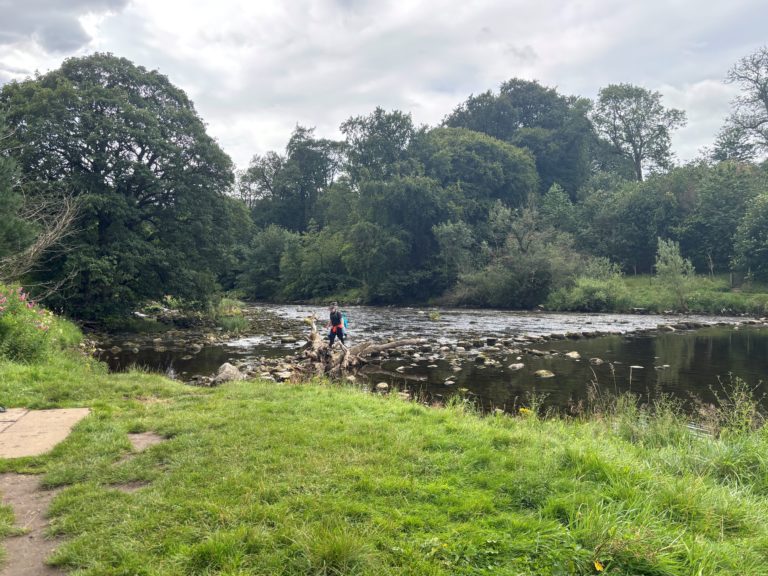
James and I were walking on Sunday and we found ourselves exploring the site of an old lead mine just above Grassington. We were not the only ones there, indeed our walk had been punctuated by ‘good mornings’ and smiles that happen frequently when you are in the wonderful Yorkshire outdoors. We had already had a joyful micro-conversation with a North York Moors volunteer who kindly held a gate open for us with a bit of showmanship.

But at this lead mine a mum and son were exploring the shale looking for ‘gems’ – which I only know because I asked! I could have walked past, but in a microsecond I chose not to, instead engaging them both in a conversation that they both willingly joined in. I think his mum appreciated that someone had shown an interest, and validated what her son and her were doing (and didn’t dismiss his ideas when he told me what he thought they had found). I also wasn’t offended when he didn’t want to show me what he had found (they were in his bag and it would be too much faff!). As the lad wandered off I suggested a place to his mum where I knew they could search for and get some info about stones and gems. in those few moments I had validated an activity, sated my curiosity and engaged in knowledge sharing. will I ever see those people again? I doubt it. Was it good for me? Absolutely.

I am not going to get into the north/south debate (divide) over who are the most spontaneously friendly or welcoming. Wherever I am in the world I will smile and engage (for the vast majority of time). And most often I will get a level of engagement back.

If anyone ever attempts to engage me, I will give a genuine and spontaneous response. Yes I do love it when someone comments on my hair, no I will never get bored of it. Yes, the phrase ‘nearly there’ when climbing up a steep hill spoken by someone either going down or overtaking me does irritate me somewhat-do I show it? Not to the person giving me encouragement! To them I will smile graciously, and attempt to receive it in the manner it is given. If my attempt at connection is ignored I take it as a reflection on where they are at that moment in time, not as a reflection on me!

Sometimes, when out walking and having a brief interaction with a fellow walker I might wonder if that is the only positive face to face interaction they have had in that day. I always hope not, but i also recognise that it might be the case, and so I do believe they matter. I believe that the connection and interaction with someone that I might only meet once in my lifetime is important, and the collection of these interactions add bright moments into my memory and knowledge of society and humanity. We do all remember those fellow humans who were kind, thoughtful, welcoming even if the interaction and conversation only lasted a few moments. Walking away with a smile is deeply powerful.


So, my last thought for you is this? how many meaningful micro-conversations are you going to have this summer? As throughout any given day there are so many opportunities to engage in a conversation. Whether it be the walker you pass, the person waiting at a bus stop, someone in a shop, that person who is in the same holiday location as you, a neighbour, or that person in a staff communal area or doorway that isn’t in your team. However long (or short) or deep (or superficial) your conversation is, you both will get something from it, and just like a smile, the benifits can longer than those few seconds (or minutes). Notice and accept them for or the bright spark they are. That is the power of a micro-conversation.

A whole week ‘Off’!

A whole week ‘Off’!

Posted on June 9, 2021

I managed a whole week ‘off’ work!

This is one of those blogs where it might appear I am showing off, because I managed to have a week where I did no work. This is actually a blog where I am thinking about how I managed to do it, how it felt and musings on how this might help you to do the same!

The week before my week off I spent some time scheduling my social media, ensuring that my ‘out of office’ email was ready to go and forewarning people that I was going to have the half term week off, and that I actually meant it! I stuck to my principle and did not download the app which would enable me to see my emails on my phone and I discussed with my partner how we both really meant it, no work for a week. This prep work I think did help me mentally prepare for the notion of a week off.

Where we were going also helped, it was the far north of Scotland where the 4G signal was spotty or non-existent. The hotel had limited wifi in some areas, so yes, I did pop onto social media a couple of times but not for ‘work’ but to share a couple of photos of the wonderful vista and let friends and family know what we were doing (and to see how they were spending their time!)

 Both laptops of mine and my partner were put into the bottom of the wardrobe and hidden by the spare blankets (from our eyes more than anyone elses). We did decide we wanted to take them ‘just in case’ but this was more so that we had them and could forget about them than to actually use them. Having them out of sight did put them out of mind!

Interestingly when I was a headteacher and in Portugal I still felt the need to constantly connect to wifi and check emails/messages. I wonder what has changed? -One thing I do know is that I was way too accessible (told people I would be regularly checking in) and with work accounts on my phone it was way too easy to do that ‘quick check in’.

Also, one person in our wider family group felt the need to do about an hour of work every day, and would go back into an area where there was signal to check her phone regularly. When I realised that she was doing this, I had a quick internal check in, did this make me anxious, did it make me want to do the same? The answer was categorically no! What I actually felt was sympathy for her that she felt she had to do this, but she felt that this was a compromise for her to have some ‘time off’ balanced into maintaining her workload. For me, I was confident that my prep work the week before and what was in my calendar for the week after was solid. However, when she was ‘off’ she really was off and none of us really talked ‘shop’ about any of our work (very diverse group) as there were so many other interesting things to chat about!

On reflection I know I’m in a much better place in how I prioritise and think about my emotional and mental health. My umbrella is strong and well maintained. This doesn’t mean that I don’t feel stressed or anxious at times, it means that I am better equipped to notice, check in with myself and do something about it. Would this have been possible as a member of SLT? Yes, I do believe so, if I had my umbrella and my boundaries and better self-awareness, (also the support of organisations such as the amazing HeadsUp4HTs).

I will admit that we returned on Friday (this had always been the plan) so that if anything major had happened work wise (for either myself or my partner) we had the weekend to check emails, phones, calendar and plan for this week. However, we spent most of the weekend with family in the sunshine in a garden, watching F1 and continuing our relaxing and recharging as we transitioned back into work mode for Monday.

Having a transitioning back into work time/space also helped, I think coming back later would have meant we had placed way too much pressure on finishing holiday (and doing the boring shopping/washing/prep) and going to work (setting alarm and feeling mental prepared) and I am becoming a fan on the transition in and the transition out. We had 6 solid days of holiday, true time off, much better than 7-10 days of ‘holiday’ but where work is done for an hour or so a day whilst on holiday. You may disagree, but however you plan your holidays, plan to be truly ‘off’, and then follow through and celebrate when you manage it!


#SelfCare-Bonus Tip

#SelfCare-Bonus Tip

Posted on February 17, 2021

On Random Acts Of Kindness day, here is a bonus #SelfCare video, all about being kind to yourself

#SelfCare-Tips 5 of my top 5

#SelfCare-Tips 5 of my top 5

Posted on February 15, 2021

Here is the final (and for me the hardest!) top tip for #SelfCare

#SelfCare-Tips 3&4 of my top 5

#SelfCare-Tips 3&4 of my top 5

Posted on February 12, 2021

Here are three and four of my five top tips for #selfcare

#SelfCare-Tips 1&2 of my top 5

#SelfCare-Tips 1&2 of my top 5

Posted on February 11, 2021

Here are the first two of five top tips for #selfcare

#SelfCare-nearly half term!

#SelfCare-nearly half term!

Posted on February 10, 2021